
How to Use Mock Exams Effectively for PMP Success
- pmpexam
- November 10, 2025
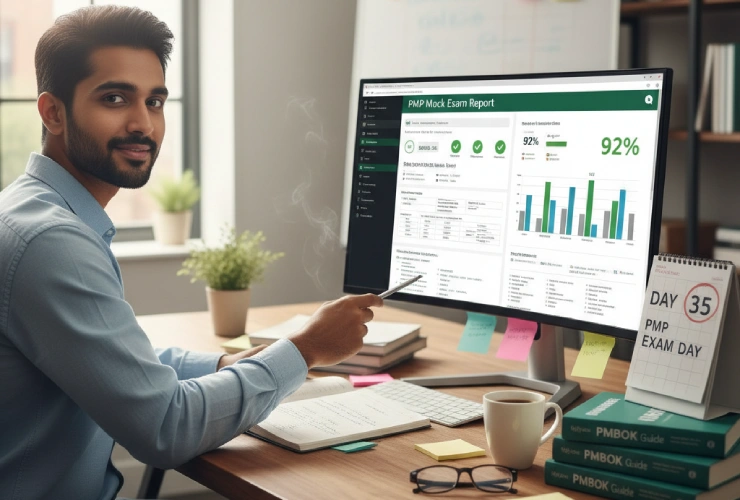
The PMP exam tests your project management skills and how you apply those skills in real-life scenarios. Candidates spend a lot of time preparing for it, but still feel ready for the test. They are overwhelmed and anxious before the exam. But this unreadiness can be solved by taking mock tests. Candidates who practice with mock tests understand their weak areas early and fix them before the exam.
However, using mock tests doesn’t mean taking mock tests after mock tests. Using them means you improve your time management and understand the format of the exam. If they are used in the right manner, they can boost your confidence and make your preparation more effective.
In this blog, we will be discussing how to use PMP mock exams strategically. We will cover why mock tests matter, the different types of mock tests available, and which one you should choose. You will also get to know some proven tips to get the most out of each mock.
Why PMP Mock Exams Matter More Than You Think
Before you start taking any mock test, it’s important to understand why they actually matter. A PMP mock exam is not just another quiz. It shows how well you can apply what you’ve studied when it actually counts.
- Real exam experience: Helps you face situational questions confidently.
- Finds weak areas: Shows topics you need to review again.
- Improves timing: Trains you to manage time under pressure.
- Builds confidence: Reduces exam fear and boosts focus.
Mock exams are where you turn your learning into real exam skills.
Types of Mock Exams and Choosing the Best
There are a lot of mock exams, and PMP candidates get confused about which ones to take. There are some mock tests that have similar questions to the exams, while there are also others that simulate the real test environment. What you need to do is use the right mix of exams to improve your chances of passing the actual PMP exam. Have a look at the different types and how to prepare for PMP exam with these mocks.
Free PMP mock exam
- Easy to access and ideal for early practice.
- Helps you get familiar with the format and terminology.
- Usually limited in coverage and lacks detailed explanations.
Paid PMP mock exam
- Covers all areas of the PMBOK Guide in depth.
- Gives explanations for both correct and incorrect answers.
- Often includes progress tracking and analytics to measure improvement.
Simulator-based exams
- Closely replicate real PMP test conditions.
- Great for testing focus and time management skills.
Traditional mock exams
- Simpler format, useful during the initial stages of preparation.
- Good for checking your understanding of core concepts before moving to full simulations.
When choosing the best PMP mock exams, make sure they:
- Follow the PMBOK and current exam content outline.
- Include scenario-based questions with variety.
- Provide detailed explanations for each answer.
- Have positive user feedback or expert recommendations.
Selecting the right mix of these exams gives you complete PMP exam help and makes your overall preparation more structured and reliable.
How to Use PMP Mock Exams Effectively
Just taking one mock exam after another won’t be helpful unless you use it with a clear strategy. Mocks are supposed to help you identify your weak areas, improve your timing, and build the mindset needed for the exam. Below is the step-by-step strategy you can use to make the most out of mock exams.
Start slow and build up.
- Begin with one PMP practice exam a week.
- Focus on understanding the logic behind each question, not just the score.
- Gradually move to full-length exams once you feel confident.
Review every mistake carefully
- Go through each incorrect answer and read the explanation.
- Note down concepts you keep getting wrong.
- Use these notes to guide what you study next week.
Track your progress
- Keep a simple log of your scores, weak areas, and improvement.
- This helps you see where you are improving and where you still need work.
Simulate real exam conditions
- Set a timer for four hours and attempt the full test in one sitting.
- Don’t take breaks unless necessary.
- This builds your focus and time management skills.
Use results for targeted revision
- After every two or three mock tests, revise your weak sections.
- You’ll start noticing patterns in mistakes, which makes your next attempt stronger.
If you follow these strategies, this will be best for PMP test preparation and will make you feel confident before the exam.
How to Analyze Your Mock Exam Results
Reviewing Mistakes and Learning from Them
Tracking Weak Areas and Patterns
After review, list the topics that caused the most trouble.
- Is it risk management or procurement?
- Are Agile questions a problem?
- Do situational or calculation items slow you down?
Spotting patterns lets you target study time where it matters. Then adjust the plan to focus on those weak spots. Small, steady fixes here pay off fast.
Time and Focus Management
Revisiting Concepts and Strengthening Foundations
Common Mistakes to Avoid When Taking PMP Mock Exams
Rushing through questions
- Many people try to finish fast, thinking it will save time for review.
- This leads to missed keywords and wrong interpretations of situational questions.
Ignoring explanations
- After a mock test, some students only check their score.
- They skip the detailed reasoning behind correct answers, which limits learning.
Repeating the same test too often
- Retaking the same PMP mock exam may improve your score artificially.
- Use different question sets so you can test your actual understanding.
Neglecting time management practice
- Some students only focus on content knowledge.
- But in the real exam, managing four hours of focus is a major challenge.
Not simulating real exam conditions.
- Taking mock tests casually, with breaks or distractions, gives a false sense of readiness.
- Always treat each test as if it’s the real thing.
Overlooking mental fatigue
- Long exams can drain focus. Practice maintaining energy and concentration throughout.
Mocks are about improving yourself and building confidence, so if you want to improve yourself self then you need to avoid these mistakes.
Conclusion
FAQs
How long does it take to prepare for the PMP exam?
Most students need around 2 to 3 months of steady study to feel confident.
Are online PMP mock exams as effective as in-person practice tests?
Yes, online mocks simulate the real exam format well and help track your timing and accuracy.
What are the best tools or websites for PMP exam preparation?
Try platforms like PMI’s study portal, PM PrepCast, and Rita Mulcahy’s PMP resources for reliable practice.
How many mock exams should I take before the actual PMP test?
Taking 5 to 7 full-length mock exams helps you test stamina and readiness for the real exam.