
What Is PMP Certification? Complete Guide to Eligibility, Exam & Career Benefits
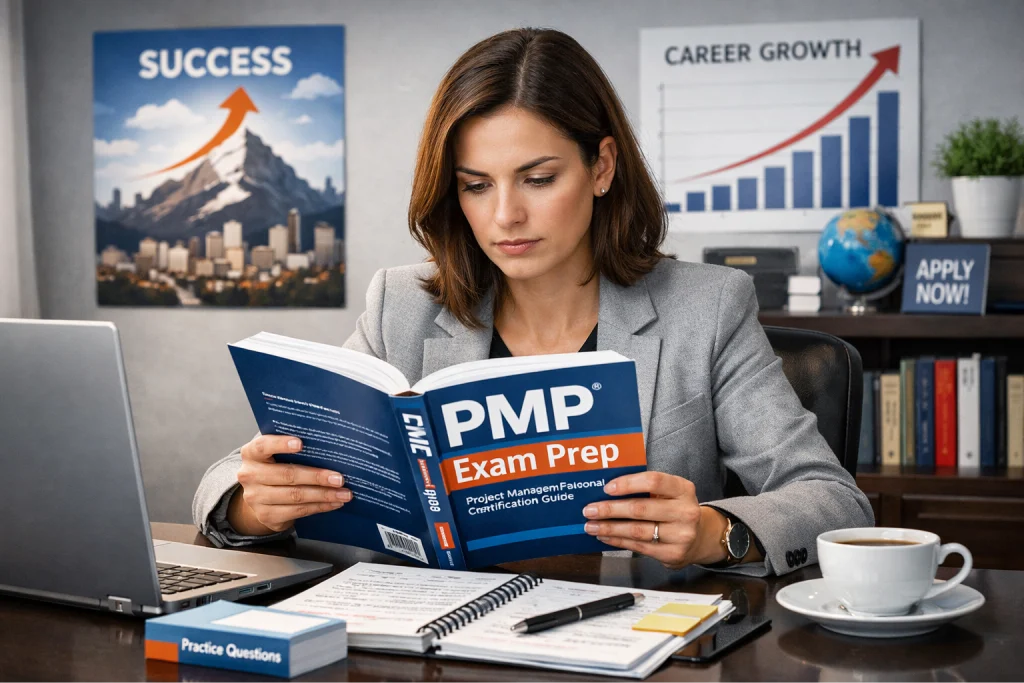
Have you ever asked yourself what is the PMP certification? If not, let’s talk about it. The golden standard certification that the Project Management Institute (PMI) offers is the one that verifies the ability of the professional to spearhead projects through Predictive, Agile and Hybrid methods.
The certification is the one that is familiar to all business spheres worldwide, and it is the official accolade of the experience of a person and his or her skills in the sphere of the successful completion of projects. The Project Management Professional qualification designation augers well with employment commitment and mastery of the stipulated best practices. It is one of the sure indications to the employer that the holder has practical knowledge of the required skills to lead people and easily navigate through the complex project boundaries without any problems.
Top PMP Certification Benefits & Salary ROI
The most significant PMP Certification benefits are that it has a definite monetary payback. Project Management Institute also reveals that professionals who obtain this credential record a 32 per cent salary increase compared to non-certified project managers. This high profitability is attributed to the need for structured leadership, higher levels of planning and risk management skills in the world. Certified professionals in the fast-moving industries like AI, software development and construction are relied upon to handle the complex and high-value projects in an efficient, strategic manner. With the rapid pace of digital transformation, organisations are actively on the lookout for PMP-certified leaders who have the ability to help align innovation with business objectives. To get a clearer picture of how PMP certification opens doors in AI-driven roles, explore how this credential positions you for long-term career growth, higher compensation, and leadership opportunities across modern industries.
PMP Certification Requirements & Eligibility (2026)
It is necessary to know the PMP certification requirements before applying. The Project Management Institute provides definite education requirements and experience in project management. There is also a requirement of 35 contact hours of formal project management education to be completed by the candidates through an approved provider. These hours will guarantee that you are familiar with the basics of various concepts, processes and best practices before you undertake the exam. They have to be undertaken by the body of approved training.
PMI can also carry out a random audit of the application. In case you are chosen, you will have to demonstrate your education, training certificate, and verified project experience. The audit is simply a regular quality test, and it does not imply the rejection of your application.
Eligibility Path Comparison
| Criteria | Degree Path | Diploma Path |
| Education | Bachelor’s degree | High school diploma |
| Project Experience | 36 months of leading projects | 60 months of leading projects |
| Training Requirement | 35 contact hours | 35 contact hours |
It is important to understand the step-by-step PMP application process, which explains all eligibility requirements, the 35 contact hours, and the necessary documentation.
PMP Certification Cost Overview: Exam, Training, and Savings
The cost of PMP certification should be planned. It is PMI member exam fee that is lower and the required 35 hours of training. Purchasing PMI membership may also help in saving the overall cost, but provides study materials to allow the candidates to strategize his/her finances well and save further on the certifications.
Exam Fee (Member vs. Non-Member)
The fee of exam paid by members of PMI is lower than that paid by non-members. In the case of 2026, it is also strongly advisable to buy a PMI membership prior to making the registration, since this will greatly reduce your overall PMP certification price. There are also valuable resources and study materials available to the members.
Training Costs
The 35 contact hours of formal project management training required for eligibility can range from a few hundred to over a thousand dollars, depending on the provider and delivery mode (online or in-person).
By understanding the breakdown, candidates can budget effectively and maximize savings, especially with PMI membership, while staying aware of the PMP exam fee changes for 2026, which outline the updated pricing for both members and non-members.
PMP Certification Exam Format & Content (ECO)
The existing PMP exam is a tough test that is aimed at challenging in the field. It has 180 questions which have to be answered within a time duration of 230 minutes and two optional breaks are provided. It relies on the Exam Content Outline (ECO) and is organized into three high-level areas, which are People (leadership and team management) and Process (technical management of projects), and Business Environment (connecting projects to the strategy of the organization). The more notable change in this PMP certification exam is that it overemphasized situational questions. It does not require memorization of definitions, but rather hypothetical situations in which the candidates have to select the most appropriate course of action under Predictive, Agile, and Hybrid methodologies. In order to pass the test, the candidates should be aware of the concepts of Agile and Hybrid framework and the art of scenario analysis. In addition, Many candidates can boost their scores through acquiring best tips on how to tackle situational questions.
How to Study for the PMP Certification
To manage the exam successfully, people have to adopt a strategic approach to study, comprising organised learning materials, effective time management, and regular performance evaluation.
Choose a Prep Course
The basis of successful preparation is investment in a good prep course. The structured program will make sure that you cover all the areas, and you will be taught how to choose the best PMP exam prep course that suits your learning needs, whether with an instructor or a self-paced course.
Create a Schedule
Devote 8-12 weeks to study, and block hours per week. A systematic PMP study roadmap is useful in ensuring that you work systematically in the domains, but also gives you time to digest the information and study difficult areas without being overwhelmed.
Take Mock Tests
Understanding the difference between mock tests vs question banks is crucial. Question banks help you practice specific topics, while full-length mock tests build stamina and familiarize you with situational questions. Both tools identify weak areas and sharpen your ability to apply concepts correctly under pressure.
Common PMP Certification Mistakes
Even inexperienced project managers fail the exam on the test day when they get caught in predictable traps, which makes preparation a nightmare. The knowledge of these pitfalls can save you time, money and disappointment of the need to redo the examination.
Rushing Without a Strategy
Many of the candidates will be in a hurry to go through the material, and this is the cause of burnout and confusion. This is the mistake every human being commits when he or she fails to recognize the depth of the right understanding. To prevent this, you should learn by example from those who have done it before, and common mistakes to avoid; otherwise, your preparation will be a hasty one. The retention to succeed in the long term is hardly accomplished through a hasty method.
Memorizing Instead of Understanding
A primary reason people fail the exam is relying on rote memorization rather than grasping PMI’s logic. The test presents situational twists where memorized facts become useless. You must internalize the “why” behind processes to study smarter, not harder and adapt to any scenario. When you understand concepts deeply, questions about unfamiliar situations become solvable through logical reasoning.
Ignoring the PMI Mindset
The real-life experience would work against you when you do not take into consideration the ideal approach of PMI. The exam is not a rush, nonchalant findings as it exercises selective reasoning- consult a plan, then act. This is an important move to be taken in a bid to navigate through the Agile and Hybrid questions that prevail in the PMP certification exam. A change in how I do this at work to how PMI expects this to be done involves a significant difference in scoring well.
Neglecting Mock Exam Reviews
One should not just pass mock tests, and it is an opportunity wasted to do a proper performance review. This habit of taking through all the wrong answers builds the psychological strength that you require to go through the 230-minute test, and weak areas will become strong before the actual attempt. As opposed to confidence checks, practice tests are effective learning activities that can be done regularly.
Conclusion: Is PMP Certification Worth It?
The knowledge of what the PMP certification demonstrates is that it helps to develop your career, make more money, and handle complex projects in the AI, software, and construction sectors. The costs of exam fees, training, and preparation are worth considering for professional development in the long run.
By practicing with a PMP exam-focused effort, it is possible to clear the PMP exam in 45 days with organized strategies and strict study schedules. Using the best online resources and communities, and networks, one becomes better reinforced in learning, up to date, and networked with other aspirants.
Your PMP journey will see you open the door to leadership, increased credibility, and increased project management opportunities today. By applying appropriate preparation, effort, and availability of quality materials, the PMP certification can be a reality and a very fulfilling goal.